If you are exhausted during the day, struggling to sleep at night and noticing changes to your cycle, it’s a good idea to test your cortisol. But a single blood sample taken at one point in the morning offers a limited view of how your stress response is working.
At FUTURE WOMAN, we believe comprehensive cortisol testing alongside your other hormones, including oestrogen, progesterone and testosterone, is essential for women. Cortisol dysregulation is at the root of many hormonal imbalances and issues that we treat. That’s because when your body is under stress, it prioritises survival over reproduction, which affects ovulation and progesterone production. A comprehensive cortisol test measures your cortisol awakening response, your daily cortisol pattern, your metabolised cortisol and your cortisone. These results together help us understand how stress is contributing to your symptoms so we can address the root cause in your 12 week plan.
Quick Takeaways
- The body prioritises survival over reproduction, so high or low cortisol can disrupt ovulation and lower progesterone
- In a study of 259 women, high daily stress doubled the odds of having a cycle without ovulation
- A single blood cortisol test is useful to diagnose acute adrenal conditions such as Cushing’s syndrome and Addison’s disease, but doesn’t provide enough information for a thorough assessment of your stress response
- A comprehensive cortisol test uses saliva to measure the cortisol awakening response and dried urine to measure the daily pattern and metabolised cortisol
- Around one in two FUTURE WOMAN clients test with low cortisol, often after years of producing high levels
Why cortisol testing is so important for women
Survival takes priority over reproduction
The hypothalamus in your brain controls two important communication pathways. The HPA (hypothalamic-pituitary-adrenal) axis controls your stress response and the HPO (hypothalamic-pituitary-ovarian) axis controls your menstrual cycle. When your body is under stress, whether from external stressors like work and relationships, or internal stressors like infections, nutrient deficiencies or poor sleep, the stress response takes priority. Functions that are less essential for survival, such as reproduction, are deprioritised.
High cortisol reduces the release of gonadotropin-releasing hormone (GnRH) from the hypothalamus. This lowers the release of FSH and LH from the pituitary gland, which are needed for healthy ovulation. You can read more about this in our articles on stress and the HPA axis and the HPO axis.
How stress affects ovulation and progesterone
Progesterone is produced by the corpus luteum after ovulation. If you don’t ovulate, you produce little progesterone in the second half of your cycle. In a study of 259 women, those with high daily perceived stress had around twice the odds of an anovulatory cycle, after adjusting for age, body fat, depression scores and exercise. High stress was also associated with lower progesterone in the luteal phase.
At FUTURE WOMAN, we believe a natural, ovulatory cycle with healthy progesterone levels should be the goal of every woman in her reproductive years. Progesterone helps not only with reproduction and pregnancy, but also with sleep and mood. When stress disrupts ovulation, you may experience symptoms of low progesterone, such as anxiety, poor sleep and shorter cycles, which are often mistaken for early perimenopause.
How stress affects common hormone conditions
Stress plays a role in many of the hormone conditions we see at FUTURE WOMAN. In some women cortisol is high, while in others it is low. We explain why cortisol can be low later in this article.
Perimenopause
Many women in their late 30s and 40s come to us because they think they are in perimenopause. When they test, their oestrogen and progesterone alone might be indicative of perimenopause, but interpreted alongside high or low cortisol we can see if stress is the real underlying driver. Stress and perimenopause also overlap: the HPA axis becomes less stable during perimenopause as hormones decline, which increases the risk of low mood and sleep problems. Our article on hormone testing in perimenopause explains how testing helps to tell the two apart.
Endometriosis
Endometriosis is an inflammatory condition and cortisol is one of the body’s main anti-inflammatory hormones. In a study of 93 women with endometriosis and 82 women without, the women with endometriosis reported higher stress levels but had lower cortisol at every time point measured. Their waking cortisol was around a quarter of the level seen in the comparison group. Long-term pain and stress may reduce cortisol output over time, which can make inflammation harder to control. You can read more in endometriosis and testing.
PCOS and PMOS
In May 2026, an international group of experts renamed PCOS as polyendocrine metabolic ovarian syndrome (PMOS) to better reflect its hormonal and metabolic features. Stress can make PCOS or PMOS symptoms worse. Cortisol raises blood sugar and insulin. Higher insulin then increases testosterone production in the ovaries. There is also a type of PCOS called adrenal PCOS, where PCOS is driven by high cortisol and high DHEA, even when testosterone levels are normal. Testing cortisol alongside DHEA and other androgens is essential for getting the full picture.
Hypothalamic amenorrhoea
In hypothalamic amenorrhoea, stress is the root cause of missing periods. The Endocrine Society’s clinical guideline identifies emotional stress, low energy intake and excessive exercise as the main causes of functional hypothalamic amenorrhoea. The brain interprets these as a threat and stops sending the signals needed for ovulation. Testing cortisol shows how your stress response has been affected, which helps us plan your recovery. Our article on hypothalamic amenorrhoea diagnosis explains the testing process.
PMDD
PMDD involves a severe sensitivity to the normal hormone changes of the luteal phase. A 2024 study of women with PMDD found that their cortisol response to a stress test in the late luteal phase was lower than in women without PMDD. The study only included 29 women, but the finding matches what our nutritionists often see in clients with PMDD – poor adrenal health is so often part of the picture. You can read more about our approach to PMDD.
If you recognise any of these conditions or symptoms, our free symptom checker takes a few minutes and can help identify the most likely hormonal causes.
What’s the best cortisol test in the UK?
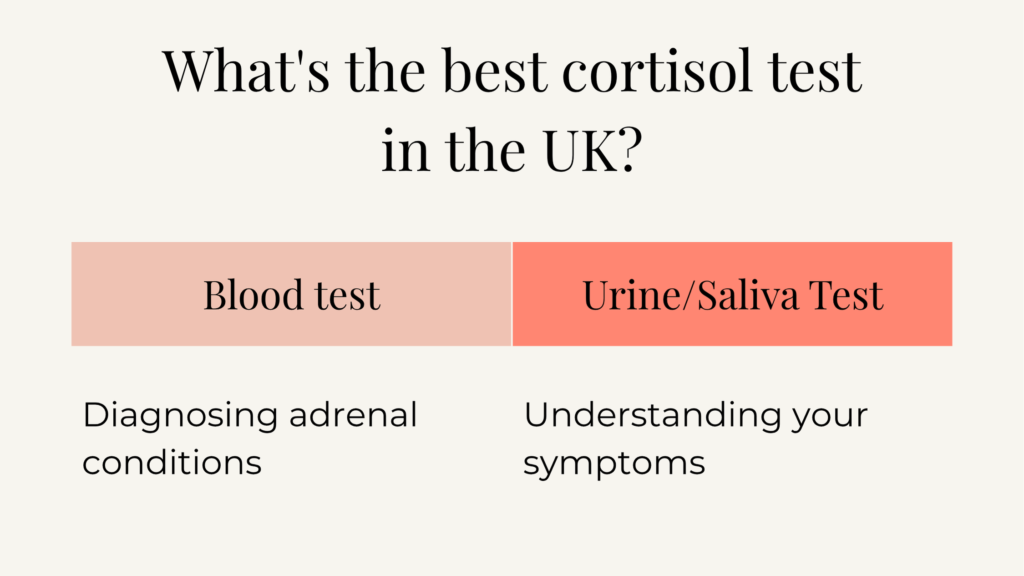
There are two main types of cortisol test available in the UK. Each one answers a different question, so the best test depends on what you want to find out.
A single blood cortisol test: for diagnosing adrenal conditions
A cortisol blood test through your GP or a private clinic measures cortisol in one sample, usually taken between 8am and 9am. Doctors use this test to screen for Cushing’s syndrome, where the body produces too much cortisol. They also use it to check for Addison’s disease, where the body produces too little. For these serious conditions, a blood test is the right starting point and abnormal results are followed up with further tests.
A saliva and dried urine cortisol test: for understanding your symptoms
Most women we test do not have an adrenal condition. Instead, they have symptoms such as fatigue, PMS, poor sleep or irregular periods and want to know whether stress is a root cause. A saliva and dried urine test measures your cortisol at several points across one day, as well as how much cortisol your body produces and breaks down. This shows how your stress response is working and how it may be affecting your other hormones, which a single blood sample can’t show.
What a comprehensive cortisol test in the UK should measure
Cortisol awakening response
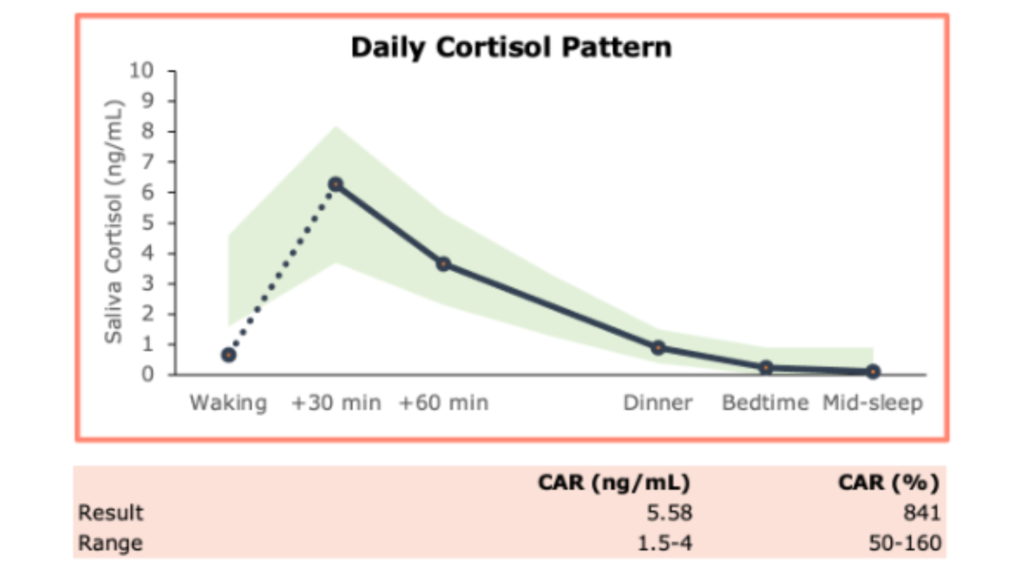
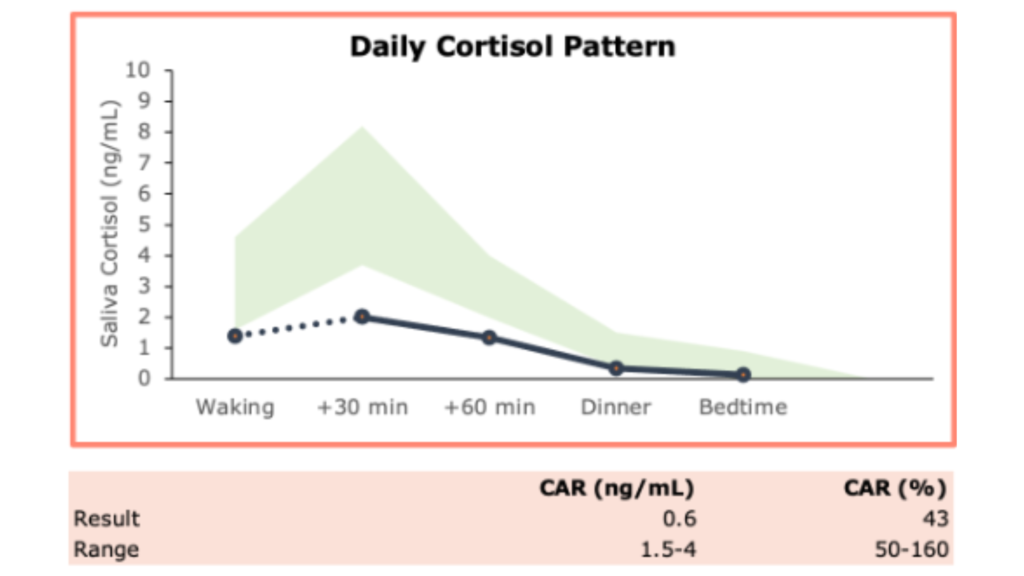
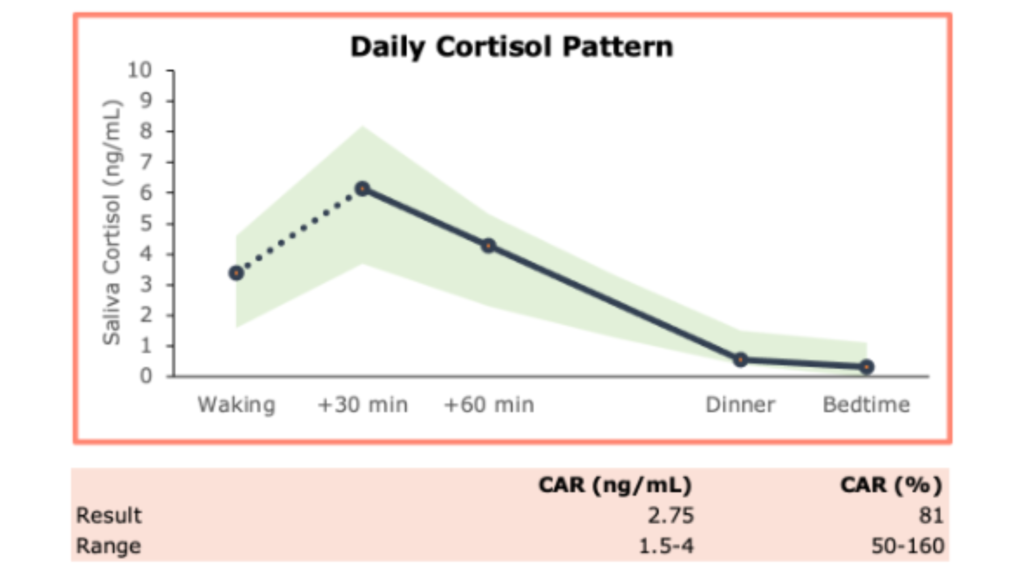
In a healthy stress response, cortisol rises by 50 per cent or more after waking and peaks around 30 minutes later. This is called the cortisol awakening response (CAR) and it acts as a mini stress test for the body. A high CAR is often associated with anticipatory stress. Research has linked a larger morning rise to the stress people expect that day. A low or blunted CAR is more common after long-term stress and burnout. A blunted CAR is almost more common in women with autoimmune conditions. In a study of women with lupus and Sjögren’s syndrome, those with the most inflammation had the lowest waking cortisol.
Daily cortisol pattern
Five saliva samples, collected from waking to bedtime, show how your free cortisol changes across the day. We look at the overall pattern as well as the individual results. For example, low cortisol in the morning and high cortisol at night often goes with difficulty getting up and difficulty falling asleep due to feeling wired.
Metabolised cortisol
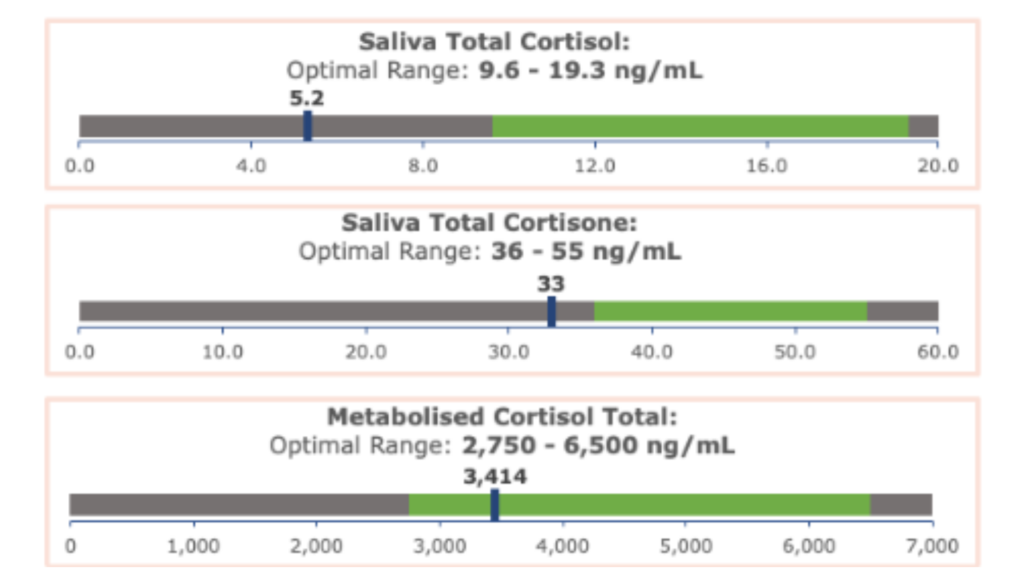
Less than 5 per cent of the cortisol in your blood is free and active. Free cortisol tests measure that small active fraction, while metabolised cortisol shows the total amount your adrenal glands have produced and your body has broken down. Looking at both helps us interpret your results correctly. High free cortisol with low metabolised cortisol, for example, can suggest slow thyroid function rather than high stress. Our article on 5 reasons to test your hormone metabolism explains this in more detail.
Cortisone
Your body converts active cortisol into inactive cortisone and back again. Measuring both shows the balance between the two, which can be influenced by inflammation and thyroid function. We also look at these results alongside DHEA, an adrenal hormone that helps balance the effects of cortisol. Our guide to cortisol and cortisone covers the different result patterns.
Why timing matters
Cortisol levels should rise after waking and gradually fall throughout the day until bedtime. Lab Tests Online UK states that a single cortisol measurement is not usually sufficient because levels vary throughout the day. It also notes that blood cortisol can be raised by the stress of having the blood test. A normal result at 9am doesn’t show whether your cortisol drops too early in the afternoon or rises again in the evening.
Why we use saliva and urine
Saliva provides a practical and accurate way of collecting cortisol at precise times across the day, which is what the cortisol awakening response and your daily free cortisol pattern need.
The addition of urine testing provides information on cortisol metabolites, which show your total cortisol production.
How does a cortisol test at home work in the UK?
Collecting your saliva samples
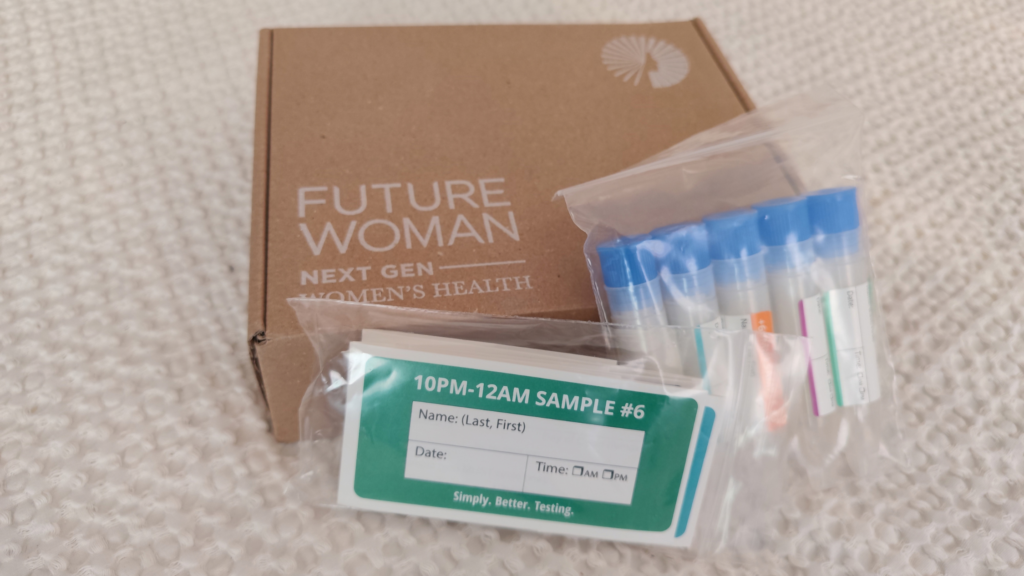
The Advanced Hormone Test kit includes saliva tubes for five collection points: on waking, 30 minutes after waking, 60 minutes after waking, in the afternoon and at bedtime. The first three samples measure your cortisol awakening response, so it helps to set an alarm for the 30 and 60 minute collections.
Collecting your dried urine samples
On the same day, you collect four urine samples on filter paper strips, from waking to bedtime. The strips dry at room temperature and you return them to the lab in a prepaid envelope. Fewer than 1 per cent of samples can’t be analysed, usually because the urine was too dilute.
When to test in your cycle
If you have a regular cycle, we aim to test in the mid luteal phase, five to seven days after ovulation. For example, in a 28 day cycle this would mean testing on days 19, 20 or 21 of your cycle. This allows us to assess your cortisol alongside progesterone when progesterone should be at its highest. If your cycle is irregular, or you are using the hormonal IUD, our team will advise you on the best day to test. If your cycle is absent, you are using other forms of hormonal contraception, or are postmenopause, you can test on any day.
Your results and personalised plan
The lab takes around two weeks to analyse your samples. One of our nutritionists then reviews your results and writes a personalised 12 week plan with supplement, diet and lifestyle recommendations.
Is it always high cortisol?
How cortisol changes with long-term stress
Cortisol is often high in the early stages of stress, but this can change over time. A review of chronic stress studies found that cortisol tends to be higher when stress first begins and lower the longer the stress continues. Over time, communication between the brain and the adrenal glands becomes dysregulated, which can lead to low cortisol production.
What we see in our clients
Around one in two women who test with FUTURE WOMAN have low cortisol. Many have spent years in demanding jobs, looking after young children or caring for parents. Common symptoms include fatigue, anxiety, difficulty getting up in the morning and frequent colds. Our article on the symptoms of burnout describes the stages of stress that can lead to this.
Why low cortisol needs a different approach
Low cortisol is still a sign of stress on the body. The support you need is different from the support for high cortisol. Some supplements that help with high cortisol may make low cortisol symptoms worse, which is why we recommend testing before starting any stress supplements.
If you often feel exhausted but can’t switch off, our symptom checker is a good place to start. It’s free and shows which hormones may be driving your symptoms.
Where to start
Testing cortisol alongside your other hormones shows how stress is affecting your cycle, your progesterone and your symptoms. A single blood test can’t measure your cortisol awakening response, your daily cortisol pattern or how much cortisol your body breaks down. The Advanced Hormone Test measures all of these alongside oestrogen, progesterone, testosterone and their metabolites. It includes a personalised 12 week plan from one of our nutritionists.
If you have PMDD, or are on a fertility journey, the Advanced+ Hormone Test with Cycle Mapping also maps your hormones across your whole cycle. Our Classic Hormone Test doesn’t include cortisol, so we recommend the Advanced or Advanced+ if stress is part of your hormone picture.
References
Schliep KC, Mumford SL, Vladutiu CJ et al. (2015). Perceived stress, reproductive hormones and ovulatory function: a prospective cohort study. Epidemiology, 26(2), 177–184. https://doi.org/10.1097/EDE.0000000000000238
Vigil P, Meléndez J, Soto H et al. (2022). Chronic stress and ovulatory dysfunction: implications in times of COVID-19. Frontiers in Global Women’s Health, 3, 866104. https://doi.org/10.3389/fgwh.2022.866104
Lab Tests Online UK. Cortisol test. https://labtestsonline.org.uk/tests/cortisol-test
Seizer L. (2024). Anticipated stress predicts the cortisol awakening response: an intensive longitudinal pilot study. Biological Psychology, 192, 108852. https://doi.org/10.1016/j.biopsycho.2024.108852
Petrelluzzi KF et al. (2008). Salivary cortisol concentrations, stress and quality of life in women with endometriosis and chronic pelvic pain. Stress. https://pubmed.ncbi.nlm.nih.gov/18800310/
Endocrine Society (2026). Polyendocrine metabolic ovarian syndrome: new name for PCOS. https://www.endocrine.org/news-and-advocacy/news-room/2026/pcos-name-change
Gordon CM, Ackerman KE, Berga SL et al. (2017). Functional hypothalamic amenorrhea: an Endocrine Society clinical practice guideline. Journal of Clinical Endocrinology and Metabolism, 102(5), 1413–1439.
Hamidovic A, Davis J, Soumare F (2024). Blunted cortisol response to acute psychosocial stress in women with premenstrual dysphoric disorder. International Journal of Neuropsychopharmacology, 27(3), pyae015.
Miller GE, Chen E, Zhou ES (2007). If it goes up, must it come down? Chronic stress and the hypothalamic-pituitary-adrenocortical axis in humans. Psychological Bulletin, 133(1), 25–45. https://doi.org/10.1037/0033-2909.133.1.25