If you’re reading this article, it’s likely that your recent test results either showed elevated or low levels of 2-Methoxy-E1. While this may sound concerning, rest assured that it’s a common marker we monitor and, importantly, one that can be addressed through personalised treatment plans.
Let’s take a closer look at what 2-Methoxy-E1 is, why optimal levels matter, and how it can impact your health.
What is 2-Methoxy-E1?
2-Methoxy-E1 (2-Methoxyestrone) is a metabolite of estrone, a key estrogen in the body. It forms when 2-hydroxyestrone (2-OH-E1) is methylated by the enzyme catechol-O-methyltransferase (COMT). This process transforms potentially harmful estrogen metabolites into more stable, less active forms that can be excreted safely. Essentially this is the process of how estrogen is safely removed from the body.
Methylation (a process of transformation in the body) is crucial for hormonal detoxification and depends on sufficient levels of cofactors like magnesium, vitamin B6, and S-adenosylmethionine (SAMe). If methylation is inefficient, harmful estrogen metabolites may accumulate, increasing risks for DNA damage and oxidative stress.
The Role of Methylation in Estrogen Detoxification
Estrogen detoxification occurs in two phases in the liver (and a third phase in the gut):
- Phase I: Estrogens are hydroxylated to form metabolites like 2-OH-E1, 4-OH-E1, or 16-OH-E1. In this phase estrogens are made more toxic before moving to phase 2.
- Phase II: Metabolites undergo further detoxification, such as methylation or sulfation, to change them from fat to water-soluble and ready for excretion.
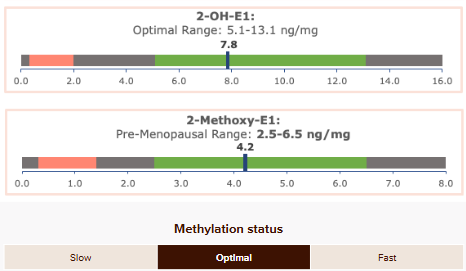
Methylation neutralises reactive Phase I metabolites, reducing oxidative stress and preventing them from re-entering circulation. A balanced ratio of 2-Methoxy-E1 to 2-OH-E1 reflects efficient methylation activity, a key factor in maintaining estrogen balance.
Methylation matters even more when there is more estrogen to clear, such as when you are in the early stages of perimenopause (when estrogen levels fluctuate) or you are taking estrogen hormone replacement therapy.
Symptoms of High and Low 2-Methoxy-E1
The luteal phase range for 2-Methoxy-E1 is 2.5-6.5 ng/mg and the post-menopausal range is 0.3-1.4 ng/mg.
Low 2-Methoxy-E1 Levels
Low levels of 2-Methoxy-E1 are linked to estrogen-dominant conditions such as endometriosis and symptoms of high estrogen like heavy and painful periods. Nutrient deficiencies (e.g., magnesium, B vitamins) or genetic issues affecting methylation enzymes (like COMT or MTHFR) may hinder its production.
Poor methylation can lead to an accumulation of oxidative estrogen metabolites, contributing to:
- Breast tenderness and swelling
- Menstrual irregularities including painful and heavy periods
- Increased inflammation
- Mood instability (e.g., anxiety or depressive symptoms due to heightened estrogenic activity).
Even if a person is metabolizing most of their estrogen into the preferred 2-OH metabolites, if these 2-OH metabolites are not adequately methylated, they can still be oxidizing. Oxidation can lead to cellular stress, poor cellular health, and increased risk for abnormal cell function leading to hormonal symptoms.
High 2-Methoxy-E1 Levels
Elevated levels of 2-Methoxy-E1 are often a sign of efficient estrogen metabolism. While generally protective, excessive levels could indicate reduced estrogenic activity, potentially leading to:
- Low libido
- Mood changes (linked to reduced neurotransmitter regulation).
Although if levels are very high this can mean estrogen is being removed too quickly from the body resulting in lower overall estrogen levels.
However, high levels are less concerning and may indicate favourable metabolism with protective effects against estrogen-related cancers. Some research suggests that postmenopausal women with increased metabolism of estrogens along the 2-pathway, leading to higher levels of 2-Methoxy-E1, could have a reduced breast cancer risk.
Understanding and managing 2-Methoxy-E1 levels is crucial for balancing estrogen metabolism and safeguarding hormonal health. However, 2-Methoxy-E1 tells you very little on its own. It only means something next to 2-OH-E1, because the ratio between the two is what shows whether you are methylating well. That is why we measure the full estrogen metabolite panel in every FUTURE WOMAN hormone test.
Next steps
If your results suggest high or low 2-Methoxy-E1 levels, this will be addressed in your personalised health plan by one of our experienced nutritionists. If you would like to learn more about your test results, remember you can purchase a 45-minute Hormone Health Consultation with your practitioner to discuss your results in more detail.
References
Al-Shami, K., Awadi, S., Khamees, A., Alsheikh, A. M., Al-Sharif, S., Ala’ Bereshy, R., Al-Eitan, S. F., Banikhaled, S. H., Al-Qudimat, A. R., Al-Zoubi, R. M., & Al Zoubi, M. S. (2023). Estrogens and the risk of breast cancer: A narrative review of literature. Heliyon, 9(9), e20224. https://doi.org/10.1016/j.heliyon.2023.e20224
Fuhrman, B. J., Schairer, C., Gail, M. H., Boyd-Morin, J., Xu, X., Sue, L. Y., Buys, S. S., Isaacs, C., Keefer, L. K., Veenstra, T. D., Berg, C. D., Hoover, R. N., & Ziegler, R. G. (2012). Estrogen metabolism and risk of breast cancer in postmenopausal women. Journal of the National Cancer Institute, 104(4), 326–339. https://doi.org/10.1093/jnci/djr531
Falk, Roni & Brinton, Louise & Dorgan, Joanne & Fuhrman, Barbara & Veenstra, Timothy & Xu, Xia & Gierach, Gretchen. (2013). Relationship of serum estrogens and estrogen metabolites to postmenopausal breast cancer risk: A nested case-control study. Breast cancer research : BCR. 15. R34. 10.1186/bcr3416.
Lakhani, N. J., Sarkar, M. A., Venitz, J., & Figg, W. D. (2003). 2-Methoxyestradiol, a promising anticancer agent. Pharmacotherapy, 23(2), 165–172. https://doi.org/10.1592/phco.23.2.165.32088