Testosterone is an androgen, and women make it in the ovaries, adrenal glands and fat tissue. It influences more than you might think: muscle, bone density, egg quality, mood, memory and libido are all affected by it.
Your result here comes from urine rather than blood, which means it reflects the testosterone your body can actually use rather than the total circulating amount. If yours came back high or low, that is common and it responds well to the right support. If you have not tested yet, testosterone is measured in all three FUTURE WOMAN tests.
Let’s take a closer look at what testosterone is, why optimal levels matter, and how it can impact your health.
What is Testosterone?
Testosterone is an androgenic steroid hormone that plays a crucial role in both male and female health. While it is often associated with men, women also produce testosterone in small but essential amounts. In females, testosterone is synthesised in the ovaries, adrenal glands, and peripheral tissues (especially fat tissue). It contributes to maintaining muscle mass, bone density, egg health and fertility, cognitive function, and sexual health.
Unlike blood testing, which measures both bound and free testosterone, urine testing primarily reflects bioavailable testosterone levels by looking at testosterone glucuronide and testosterone sulfate. Additionally, analysing testosterone metabolites, such as 5α-DHT, provides deeper insights into androgen metabolism and potential hormonal imbalances.
Symptoms of high and low testosterone
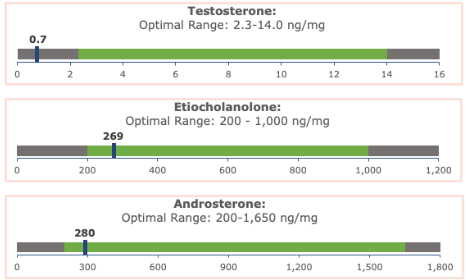
The optimal luteal range for testosterone is age dependent;
Age 20-39 = 2.3-14ng/mg
Age 40-60 = 2.3-8ng/mg
Age >60 = 1.5-6.3ng/mg
High testosterone levels
Elevated testosterone levels in women can result from various factors, including insulin resistance, adrenal dysfunction, inflammation, genetic predispositions, and chronic stress. One of the most common causes is polycystic ovary syndrome (PCOS), a condition characterised by irregular ovulation and metabolic disturbances. Find out more about PCOS here.
Symptoms of high testosterone may include:
- Acne and oily skin
- Unexplained weight gain
- Irregular or absent periods
- Increased facial and body hair (hirsutism)
- Scalp hair thinning or male-pattern baldness
- Anxiety, mood swings, or irritability
- Deepening of the voice
- Fertility challenges
Testosterone can also be converted into a more potent androgen, dihydrotestosterone (DHT), through the 5-alpha reductase pathway. Excess DHT (which is 3x more potent than testosterone) can exacerbate symptoms like hair loss, acne, and increased body hair growth.
Low testosterone levels
Testosterone naturally declines with age, but low levels can also be caused by factors such as excessive exercise, chronic stress, nutritional deficiencies, pituitary dysfunction, and the use of hormonal contraceptives.
Symptoms of low testosterone include:
- Low libido
- Persistent fatigue and low energy
- Mood disturbances, including depression and anxiety
- Muscle weakness and difficulty maintaining muscle mass
- Increased body fat, particularly around the abdomen
- Thinning hair and dry skin
- Irregular or anovulatory menstrual cycles
- Reduced bone density, increasing the risk of osteoporosis
It is important to note that low testosterone is linked to poor egg quality and fertility issues, this is something your practitioner will take into consideration if pregnancy is one of your goals in the near future.
Testosterone falls gradually with age rather than dropping away at menopause, so a low result in your forties is worth reading alongside your oestrogen and progesterone. If you are in perimenopause, our guide to the perimenopause hormone test covers what to test and when.
Genetic Variants and Urinary Testosterone Levels
Testosterone levels in urine can appear artificially low due to genetic variants affecting the UGT2B17 enzyme, which is responsible for conjugating testosterone into its glucuronide form for excretion. A gene deletion in UGT2B17 results in reduced enzyme activity, leading to lower urinary testosterone levels without significantly impacting serum levels.
This genetic variant is most prevalent in individuals of Asian descent (affecting over 60%) but is much rarer in other populations (less than 10% in most groups and around 1–2% in Caucasians). While this deletion does not generally cause physiological issues, some studies suggest it may prolong testosterone activity in the body, potentially contributing to improved bone mineral density in women.
Since UGT2B17 primarily forms testosterone glucuronide, individuals with genetic variants of this enzyme exhibit lower urinary levels of testosterone, 5α-DHT, and 5β-androstanediol, even if their blood testosterone levels remain unaffected. The impact of this variant varies by genetic ancestry, with heterozygous individuals showing milder reductions compared to homozygous individuals. This is nothing to be concerned about but sometimes we ask clients to have their testosterone tested via blood with their GP’s to double check if they have adequate levels via blood before treatment.
How can you test testosterone levels?
You can measure your testosterone levels in any FUTURE WOMAN hormone test: the Classic Hormone Test, the Advanced Hormone Test and the Advanced+ Hormone Test with Cycle Mapping.
If you are not sure which test you need, our comparison guide walks through the differences.
Next steps
If your results suggest high or low testosterone, this will be addressed in your personalised health plan by one of our experienced nutritionists. If you would like to learn more about your test results, remember you can purchase a 45 minute Hormone Health Consultation with your practitioner to discuss your results in more detail.
References
Alemany M. (2022). The Roles of Androgens in Humans: Biology, Metabolic Regulation and Health. International journal of molecular sciences, 23(19), 11952. https://doi.org/10.3390/ijms231911952
Bizuneh, A. D., Joham, A. E., Teede, H., Mousa, A., Earnest, A., Hawley, J. M., Smith, L., Azziz, R., Arlt, W., & Tay, C. T. (2025). Evaluating the diagnostic accuracy of androgen measurement in polycystic ovary syndrome: a systematic review and diagnostic meta-analysis to inform evidence-based guidelines. Human reproduction update, 31(1), 48–63. https://doi.org/10.1093/humupd/dmae028
Carmina, E., Dreno, B., Lucky, W. A., Agak, W. G., Dokras, A., Kim, J. J., Lobo, R. A., Ramezani Tehrani, F., & Dumesic, D. (2022). Female Adult Acne and Androgen Excess: A Report From the Multidisciplinary Androgen Excess and PCOS Committee. Journal of the Endocrine Society, 6(3), bvac003. https://doi.org/10.1210/jendso/bvac003
Davis, S. R., & Wahlin-Jacobsen, S. (2015). Testosterone in women–the clinical significance. The lancet. Diabetes & endocrinology, 3(12), 980–992. https://doi.org/10.1016/S2213-8587(15)00284-3
Kinter KJ, Amraei R, Anekar AA. Biochemistry, Dihydrotestosterone. [Updated 2023 Jul 30]. In: StatPearls [Internet]. Treasure Island (FL): StatPearls Publishing; 2025 Jan-. Available from: https://www.ncbi.nlm.nih.gov/books/NBK557634/
Zhu, A. Z., Cox, L. S., Ahluwalia, J. S., Renner, C. C., Hatsukami, D. K., Benowitz, N. L., & Tyndale, R. F. (2015). Genetic and phenotypic variation in UGT2B17, a testosterone-metabolizing enzyme, is associated with BMI in males. Pharmacogenetics and genomics, 25(5), 263–269. https://doi.org/10.1097/FPC.0000000000000135