DHEA-S is the most abundant steroid hormone in your body, and your adrenal glands make almost all of it. It is the raw material your body draws on to make testosterone and estrogen, and it also influences bone health, immunity, memory and mood.
It is also the counterweight to cortisol, which is why we read it alongside your stress markers rather than on its own. If yours came back high or low, that is common and it responds well to the right support. If you have not tested yet, DHEA-S is measured in all three FUTURE WOMAN tests.
Let’s take a closer look at what DHEA/DHEA-S is, why optimal levels matter, and how it can impact your health.
What is DHEA-S
Dehydroepiandrosterone sulfate (DHEA-S) is the most abundant steroid hormone in the human body. Produced primarily by the adrenal glands, it serves as a precursor to androgens and estrogens, playing a critical role in hormonal balance, metabolism, immune function, and bone health. Unlike its unsulfated counterpart, DHEA, which fluctuates throughout the day, DHEA-S maintains stable levels, making it a reliable marker for adrenal function.
DHEA-S is essential for:
- Sex Hormone Production: DHEA can convert back and forth to androstenedione which can then convert into testosterone and estrogen, impacting reproductive health and sexual function.
- Metabolism & Energy: Supports fat breakdown, insulin sensitivity, and glucose metabolism.
- Immune Function: Regulates immune response and inflammation.
- Cognitive Health: Contributes to memory, mood stability, and neuroprotection.
- Bone Strength: Stimulates osteoblast activity, promoting bone density and collagen synthesis.
DHEA-S testing offers a comprehensive picture of adrenal function and hormonal balance, helping diagnose and manage a range of conditions, including:
1. Adrenal Function & Stress Regulation
DHEA-S is a key marker of adrenal health. Since it counterbalances cortisol, especially protecting the brain from the effects of elevated cortisol, abnormalities in DHEA-S levels can indicate chronic stress, adrenal insufficiency, or adrenal hyperactivity. Low levels may suggest burnout, while high levels can indicate adrenal hyperplasia or excessive stress adaptation.
2. Hormonal Balance & Aging
DHEA-S levels naturally decline with age, impacting:
- Bone density (increasing the risk of osteoporosis)
- Muscle mass & metabolism
- Libido & sexual function
- Cognitive function & mood stability
Testing helps assess whether hormonal changes due to aging are contributing to symptoms like fatigue, weight gain, or reduced libido.
3. Polycystic Ovary Syndrome (PCOS)
Women with PCOS/PMOS can have elevated DHEA-S, leading to androgenic symptoms like excessive hair growth, acne, and menstrual irregularities. Testing DHEA-S levels can help in diagnosing and managing PCOS by determining adrenal involvement in excess androgen production.
4. Fertility & Reproductive Health
DHEA-S influences ovulation and menstrual cycles. High levels may contribute to anovulation and infertility, while low levels can affect hormonal balance necessary for conception. Testing helps optimize fertility treatments and assess hormonal causes of reproductive issues.
5. Inflammation
If your DHEA-S is low but your total DHEA is not, this could be a sign of inflammation. Your body is making the hormone but struggling to convert it into its storage form.
Inflammation can impair the conversion of DHEA to its sulfated form, DHEA-S, primarily by downregulating the activity and expression of the sulfotransferase enzyme SULT2A1. Pro-inflammatory cytokines such as IL-6, TNF-α, and IL-1β suppress SULT2A1, leading to reduced DHEA sulfation and a low DHEA-S to DHEA ratio. This pattern is commonly observed in chronic inflammatory conditions, and can be a marker of underlying systemic inflammation, particularly if cortisol is elevated (reflecting HPA axis activation).
Symptoms of High & Low DHEA-S Levels
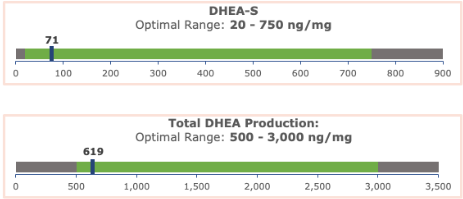
The optimal range for DHEA-S is age dependant;
- Age 20-39 = 60-750ng/mg
- Age 40-60 = 30-350ng/mg
- Age >60 = 20-150ng/mg
Total DHEA production is DHEA-S and the downstream metabolites Etiocholanolone and Androsterone added together. The optimal range for total DHEA production is also age dependant;
- Age 20-39 = 1300-3000ng/mg
- Age 40-60 = 750-2000ng/mg
- Age >60 = 500-1200ng/mg
Symptoms of high DHEA-S levels
Excessive DHEA-S can lead to symptoms of androgen dominance, including:
- Hirsutism: excess facial & body hair
- Acne & oily skin: overactive sebaceous glands
- Irregular or missed periods
- Infertility: disrupted ovulation
- Hair thinning: female pattern baldness
- Increased muscle mass & voice deepening
- Mood swings & irritability
- Sleep disturbances
Causes of High DHEA-S include;
- Adrenal tumors (benign or malignant)
- Polycystic Ovary Syndrome (PCOS) or PMOS
- Congenital adrenal hyperplasia (CAH)
- Cushing’s Syndrome (excess cortisol production)
- DHEA supplementation or medication effects
- Chronic stress response
Symptoms of low DHEA-S
A deficiency in DHEA-S can lead to:
- Fatigue & low energy
- Depression & anxiety
- Decreased libido & sexual dysfunction
- Osteoporosis & weak bones
- Weakened immune function & frequent infections
- Weight gain & insulin resistance
- Cognitive decline & memory issues
Causes of Low DHEA-S include;
- Adrenal insufficiency (underactive adrenal glands)
- Chronic stress & burnout (cortisol-DHEA imbalance)
- Autoimmune disorders affecting the adrenals
- Aging & natural hormonal decline
- Nutrient deficiencies & poor diet
- Inflammation
DHEA-S falls steadily from your late twenties onwards, so a lower result in your forties is expected rather than alarming, and what matters is where it sits against your cortisol. If you are in perimenopause, our guide to the perimenopause hormone test covers what to test and when.
Which tests measure DHEA-S?
All our FUTURE WOMAN tests measure DHEA-S: the Classic Hormone Test, the Advanced Hormone Test and the Advanced+ Hormone Test with Cycle Mapping.
Cortisol is only in the Advanced and Advanced+. Since DHEA-S is the counterweight to cortisol, the two markers tell you far more together than either does alone, so choose one of those two if adrenal health is what you came for.
If you are not sure which test you need, our comparison guide walks through the differences.
Next steps
If your results suggest high or low DHEA-S, this will be addressed in your personalised health plan by one of our experienced nutritionists. If you would like to learn more about your test results, remember you can purchase a 45 minute Hormone Health Consultation with your practitioner to discuss your results in more detail.
References
Dutheil, F., de Saint Vincent, S., Pereira, B., Schmidt, J., Moustafa, F., Charkhabi, M., Bouillon-Minois, J. B., & Clinchamps, M. (2021). DHEA as a Biomarker of Stress: A Systematic Review and Meta-Analysis. Frontiers in psychiatry, 12, 688367. https://doi.org/10.3389/fpsyt.2021.688367
Lennartsson, A. K., Arvidson, E., Börjesson, M., & Jonsdottir, I. H. (2022). DHEA-S production capacity in relation to perceived prolonged stress. Stress (Amsterdam, Netherlands), 25(1), 105–112. https://doi.org/10.1080/10253890.2021.2024803
Marcatto, F., Patriarca, E., Bramuzzo, D., Lucci, E., & Larese Filon, F. (2024). Job demands and DHEA-S levels: a study on healthcare workers. Occupational medicine (Oxford, England), 74(3), 225–229. https://doi.org/10.1093/occmed/kqae017
Mazza, E., Maccario, M., Ramunni, J., Gauna, C., Bertagna, A., Barberis, A. M., Patroncini, S., Messina, M., & Ghigo, E. (1999). Dehydroepiandrosterone sulfate levels in women. Relationships with age, body mass index and insulin levels. Journal of endocrinological investigation, 22(9), 681–687. https://doi.org/10.1007/BF03343629
Nenezic, N., Kostic, S., Strac, D. S., Grunauer, M., Nenezic, D., Radosavljevic, M., Jancic, J., & Samardzic, J. (2023). Dehydroepiandrosterone (DHEA): Pharmacological Effects and Potential Therapeutic Application. Mini reviews in medicinal chemistry, 23(8), 941–952. https://doi.org/10.2174/1389557522666220919125817
Yasui, T., Matsui, S., Tani, A., Kunimi, K., Yamamoto, S., & Irahara, M. (2012). Androgen in postmenopausal women. The journal of medical investigation : JMI, 59(1-2), 12–27. https://doi.org/10.2152/jmi.59.12