Many women are told their cortisol is normal but still feel exhausted or burnt out. But there are many important nuances to testing cortisol.
Cortisol has three readings that matter. Free cortisol is the active portion your tissues actually see. Cortisone is the inactive form your kidneys convert some of it into. Metabolised cortisol is the total you produced across the day. Measuring free cortisol alone therefore doesn’t provide the full picture. Cortisol is measured in the Advanced and Advanced+ tests, not the Classic.
Let’s take a closer look at what cortisol and cortisone are, why optimal levels matter, and how it can impact your health.
What Is Cortisol and Cortisone?
Cortisol is a steroid hormone produced by the adrenal glands, which sit on top of the kidneys. It is often called the “stress hormone” because it is released in response to stress, but it also plays a role in metabolism, immune function, blood sugar regulation, and inflammation control.
Cortisone, on the other hand, is an inactive form of cortisol. The body can convert cortisone into cortisol when needed and vice versa through specific enzymes. The balance between cortisol and cortisone helps regulate stress response and inflammation.
How Does Cortisol Work in the Body?
Cortisol production is controlled by the hypothalamic-pituitary-adrenal (HPA) axis, a communication system between the brain and adrenal glands. Here’s how it works:
- The hypothalamus in the brain releases corticotropin-releasing hormone (CRH) when the body needs cortisol.
- CRH signals the pituitary gland to release adrenocorticotropic hormone (ACTH).
- ACTH then stimulates the adrenal glands to produce and release cortisol into the bloodstream.
- Once enough cortisol is circulating, it provides negative feedback to the brain, signaling it to slow down production, maintaining balance.
Cortisol follows a natural diurnal rhythm:
- It is highest in the morning, right after waking, helping with energy, focus, and metabolism.
- It gradually declines throughout the day, reaching its lowest levels at night to promote restful sleep.
Cortisol testing can help assess adrenal health, stress resilience, and metabolic function. It is particularly useful for diagnosing conditions like:
- Chronic stress and adrenal dysfunction
- Fatigue and burnout
- Sleep disturbances
- Anxiety and depression
- Metabolic issues like insulin resistance and obesity
- Autoimmune disorders
How Is Cortisol Measured?
The Advanced Hormone Test measures:
- Free cortisol (a-THF and b-THF) – The active form of cortisol that interacts with tissues and affects how you feel.
- Cortisone levels (b-THE)– To assess how much cortisol is being inactivated.
- Metabolized cortisol (THF + THE) – The total amount of cortisol produced and processed by the body throughout the day.
- Total DHEA production – helps to understand how the HPA axis is working.
- CAR – Cortisol awakening response
Measuring both free and metabolized cortisol gives a more complete picture of adrenal function than just testing one or the other.
Cortisone
Cortisone is the inactive form of cortisol. When we measure cortisol levels in urine or saliva, we must also measure cortisone because some of the free cortisol entering the kidneys is converted into cortisone before being excreted. If free cortisol alone is measured, results could be misleading. For example:
- A person’s free cortisol may appear low, but if free cortisone is high, this suggests cortisol is actually higher in circulation than it appears.
- By looking at both free cortisol and free cortisone, we can get a more accurate assessment of true cortisol levels in the body.
Symptoms of high and low cortisol
When testing for cortisol, we look at cortisol metabolites, including cortisone, and total DHEA production.
The reference ranges for cortisol/cortisone metabolites are;
- a-Tetrahydrocortisol (a-THF) 75-370ng/mg
- b-Tetrahydrocortisol (b-THF) 1050-2500ng/mg
- b-Tetrahydrocortisone (b-THE) 1550-3800ng/mg
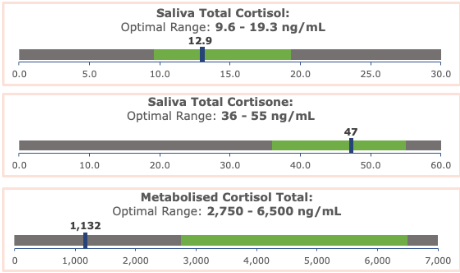
- Metabolised cortisol (THF+THE) 2750-6500 ng/mg
The reference ranges for Total DHEA production (DHEA-S + Etiocholanolone + Androsterone) is age dependant;
- Age 20-39 = 1300-3000ng/mg
- Age 40-59 = 750-2000ng/mg
- Age >60 = 500-1200ng/mg
What Do Different Cortisol Patterns Mean?
By analyzing cortisol levels throughout the day, we can identify specific patterns that may indicate underlying health issues. Your practitioner will have analysed yours and put it into context with the rest of your results.
Cortisol Clearance Rate (CCR)
Cortisol metabolism and clearance rate (CCR) can be estimated by comparing total free cortisol and cortisone with metabolized cortisol.
- Fast CCR: High metabolized cortisol but low free cortisol – cortisol is being broken down too quickly.
- Slow CCR: Low metabolized cortisol but high/normal free cortisol – cortisol is not being cleared properly.
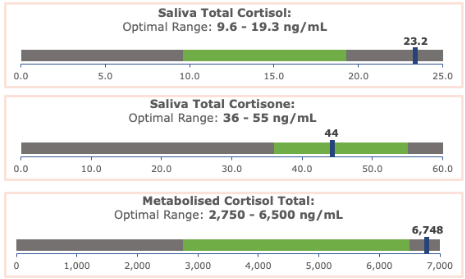
High Free Cortisol + High Metabolized Cortisol
Can indicate an acute stress response (Hyperactive adrenal output).
Potential causes:
- Chronic psychological stress
- Acute illness, pain, or inflammation
- Overtraining (excessive exercise)
- High caffeine intake
- Thyroid overactivity (hyperthyroidism)
Symptoms:
- Anxiety, restlessness
- Insomnia
- Increased appetite and sugar cravings
- Weight gain (especially around the midsection)
Low Free Cortisol + High Metabolized Cortisol
Indicates rapid cortisol clearance (Fast cortisol metabolism).
Potential causes:
- Long-term stress leading to adrenal overdrive
- Hyperthyroidism
- Insulin resistance or obesity
- Chronic inflammation or infection
Symptoms:
- Fatigue despite high total cortisol production
- Blood sugar imbalances
- Frequent colds and infections
- Poor stress tolerance
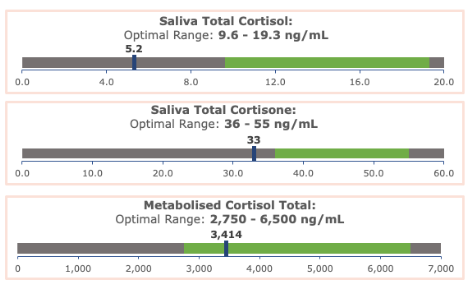
Low Free Cortisol + Low Metabolized Cortisol
Indicates adrenal insufficiency or burnout (HPA axis dysfunction).
Potential causes:
- Chronic stress exhaustion
- Adrenal fatigue
- Pituitary dysfunction
- Poor thyroid health
- Autoimmune conditions affecting the adrenals
Symptoms:
- Extreme fatigue
- Low motivation and brain fog
- Difficulty waking up in the morning
- Low blood pressure and dizziness
Low Metabolized Cortisol + High/Normal Free Cortisol
Indicates slow cortisol metabolism and clearance.
Potential causes:
- Hypothyroidism
- Liver dysfunction
- Chronic medication use (steroids, opioids, or Accutane)
- Traumatic brain injury
- Anorexia
Symptoms:
- Fatigue and sluggishness
- Cold intolerance
- Weight gain
- Depression
Cortisol and DHEA
DHEA (Dehydroepiandrosterone) is another hormone produced by the adrenal glands that helps balance cortisol’s effects.
A high cortisol-to-DHEA ratio suggests chronic stress and can lead to:
- Fatigue & burnout
- Weak immunity
- Weight gain
- Hormonal imbalances
A low cortisol-to-DHEA ratio may indicate adrenal overactivity, seen in conditions like PCOS/PMOS and adrenal hyperplasia.
Which tests measure cortisol and cortisone?
Free cortisol, cortisone and metabolised cortisol are measured in the Advanced Hormone Test and the Advanced+ Hormone Test with Cycle Mapping. The Classic Hormone Test does not include them.
If you are not sure which test you need, our comparison guide walks through the differences.
Next steps
If your results suggest high or low cortisol and/or cortisone, this will be addressed in your personalised health plan by one of our experienced nutritionists. If you would like to learn more about your test results, remember you can purchase a 45 minute Hormone Health Consultation with your practitioner to discuss your results in more detail.
References
Blair, J., Adaway, J., Keevil, B., & Ross, R. (2017). Salivary cortisol and cortisone in the clinical setting. Current opinion in endocrinology, diabetes, and obesity, 24(3), 161–168. https://doi.org/10.1097/MED.0000000000000328
Karadag, A. S., Takci, Z., Ertugrul, D. T., Bilgili, S. G., Balahoroglu, R., & Takir, M. (2015). The effect of different doses of isotretinoin on pituitary hormones. Dermatology (Basel, Switzerland), 230(4), 354–359. https://doi.org/10.1159/000375370
Karadag, A. S., Ertugrul, D. T., Tutal, E., & Akin, K. O. (2011). Isotretinoin influences pituitary hormone levels in acne patients. Acta dermato-venereologica, 91(1), 31–34. https://doi.org/10.2340/00015555-1013
Kramer, A. C., Neubauer, A. B., Stoffel, M., Voss, A., & Ditzen, B. (2019). Tomorrow’s gonna suck: Today’s stress anticipation predicts tomorrow’s post-awakening cortisol increase. Psychoneuroendocrinology, 106, 38–46. https://doi.org/10.1016/j.psyneuen.2019.03.024
Lennartsson, A. K., Arvidson, E., Börjesson, M., & Jonsdottir, I. H. (2022). DHEA-S production capacity in relation to perceived prolonged stress. Stress (Amsterdam, Netherlands), 25(1), 105–112. https://doi.org/10.1080/10253890.2021.2024803
Laudenslager, M. L., Calderone, J., Philips, S., Natvig, C., & Carlson, N. E. (2013). Diurnal patterns of salivary cortisol and DHEA using a novel collection device: electronic monitoring confirms accurate recording of collection time using this device. Psychoneuroendocrinology, 38(9), 1596–1606. https://doi.org/10.1016/j.psyneuen.2013.01.006
Law, R., & Clow, A. (2020). Stress, the cortisol awakening response and cognitive function. International review of neurobiology, 150, 187–217. https://doi.org/10.1016/bs.irn.2020.01.001
Marcatto, F., Patriarca, E., Bramuzzo, D., Lucci, E., & Larese Filon, F. (2024). Job demands and DHEA-S levels: a study on healthcare workers. Occupational medicine (Oxford, England), 74(3), 225–229. https://doi.org/10.1093/occmed/kqae017