If you’re reading this article, it’s likely that your recent test results either showed elevated or low levels of estriol. While this may sound concerning, rest assured that it’s a common marker we monitor and, importantly, one that can be addressed through personalised treatment plans.
Let’s take a closer look at what estriol is, why optimal levels matter, and how it can impact your health.
What is Estriol (E3)?
Estrogen is converted into three primary forms: estrone (E1), estradiol (E2), and estriol (E3), through the action of CYP enzymes.
Estrogens exert their effects by binding to estrogen receptors, found in various tissues, including:
- Reproductive tissues: e.g., the endometrium.
- Non-reproductive tissues: e.g., bone, breast tissue, and the brain.
Estrogen is essential for reproductive health, but its influence extends to the cardiovascular, skeletal, neurological, and immune systems. While it provides many protective effects, its levels must be well-regulated, as imbalances can lead to health issues such as estrogen dominance or deficiency.
Estriol (E3) is produced in significant amounts during pregnancy. It is produced by the placenta and helps keep the uterus and baby healthy, rising as pregnancy develops. When not pregnant, E3 is present in smaller amounts, but it still contributes to the overall balance of estrogen in the body. It is the weakest of the three estrogen types and has an affinity for beta estrogen receptors, which are more regulatory than the alpha receptors, which can promote growth. Estriol is irreversibly produced by estradiol (E2) but it is much less potent (estradiol is 80x more potent).
Estriol and HRT
Estriol is being used more in bioidentical HRT regimens because it is less potent than estradiol and effectively treats symptoms of menopause without significantly stimulating breast or endometrial tissue. Evidence indicates that estriol has potential immunomodulatory benefits for many disease states including autoimmune, inflammatory, and neurodegenerative conditions.
Symptoms of High and Low E3 Levels
The luteal phase range for E3 is 5-18 ng/mg and the post-menopausal range is 0.6-4 ng/mg.
High E3 Levels:
High E3 levels can be caused by stress and unhealthy lifestyle choices which can disrupt hormone balance. Medications, like HRT or hormonal birth control, as well as certain conditions, such as liver disease or obesity, can lead to higher E3 levels, as can certain genetic SNP preferences in your estrogen pathways.
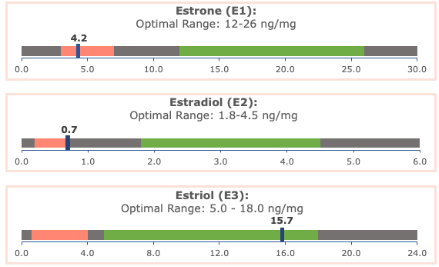
High estriol can may contribute to high overall estrogen, causing estrogen dominant symptoms such as;
- Weight gain (especially in the hips and thighs)
- Anxiety and depression
- Breast tenderness
- Irregular menstrual cycles
- Heavy menstrual cycles
- Brain fog
- Fatigue
- Fibroids and polyps
Estriol is metabolised via the 16-OH pathway (16-OH-E1) , so high levels of the potentially protective/weak estriol may also mean higher levels of the more estrogenic 16-OH-E1 which can lead to symptoms of high estrogen. So, it is important to look at E3 alongside the estrogen metabolites.
Low E3 Levels:
Low estriol levels can occur due to stress, overexercise, menopause or conditions like thyroid disorders or adrenal insufficiency. Low E3 may be indicative of overall low estrogen and common symptoms include:
- Bone loss
- Low libido
- Vaginal dryness
- Hot flashes and night sweats
- Fatigue and low energy
- Mood changes
- Weight cain, especially around the abdomen
Next steps
We test all three estrogens in our tests at FUTURE WOMAN. Testing is important to understand what to do next.
If your results suggest high or low E3 levels, this will be addressed in your personalised health plan by one of our experienced nutritionists. If you would like to learn more about your test results, remember you can purchase a 45-minute Hormone Health Consultation with your practitioner to discuss your results in more detail.
References
Ali, E. S., Mangold, C., & Peiris, A. N. (2017). Estriol: emerging clinical benefits. Menopause (New York, N.Y.), 24(9), 1081–1085. https://doi.org/10.1097/GME.0000000000000855
Lee, S.H., Kim, S.O., Lee, H.D. & Chung, B.C., 1998. Estrogens and polyamines in breast cancer: their profiles and values in disease staging. Cancer Letters, 133(1), pp.47-56.
Qureshi, R., Picon-Ruiz, M., Aurrekoetxea-Rodriguez, I., Nunes de Paiva, V., D’Amico, M., Yoon, H., Radhakrishnan, R., Morata-Tarifa, C., Ince, T., Lippman, M. E., Thaller, S. R., Rodgers, S. E., Kesmodel, S., Vivanco, M. D. M., & Slingerland, J. M. (2020). The Major Pre- and Postmenopausal Estrogens Play Opposing Roles in Obesity-Driven Mammary Inflammation and Breast Cancer Development. Cell metabolism, 31(6), 1154–1172.e9. https://doi.org/10.1016/j.cmet.2020.05.008
Xu, S., Sun, J., Zhang, Y., Ji, J. & Sun, X., 2021. Opposite estrogen effects of estrone and 2-hydroxyestrone on MCF-7 sensitivity to the cytotoxic action of cell growth, oxidative stress and inflammation activity. Ecotoxicology and Environmental Safety, 209, p.111754
Zhu, B. T., Han, G. Z., Shim, J. Y., Wen, Y., & Jiang, X. R. (2006). Quantitative structure-activity relationship of various endogenous estrogen metabolites for human estrogen receptor alpha and beta subtypes: Insights into the structural determinants favoring a differential subtype binding. Endocrinology, 147(9), 4132–4150. https://doi.org/10.1210/en.2006-0113Ziegler, R. G., Fuhrman, B. J., Moore, S. C., & Matthews, C. E. (2015). Epidemiologic studies of estrogen metabolism and breast cancer. Steroids, 99(Pt A), 67–75. https://doi.org/10.1016/j.steroids.2015.02.015