2-OH-E1, or 2-hydroxyestrone, is one of three routes your body can take when it breaks estrone down in the first phase of estrogen detoxification. It is the route you want most of your estrogen travelling down, because 2-OH-E1 binds only weakly to estrogen receptors and is the most stable of the three.
Your result is read as a percentage of all three Phase I metabolites as well as the number on its own, so a low 2-OH-E1 usually means more of your estrogen is moving down the 16-OH or 4-OH routes instead. That is common and it responds well to the right support.
If you have not tested yet, 2-OH-E1 is measured in all three FUTURE WOMAN tests.
Let’s take a closer look at what 2-OH-E1 is, why optimal levels matter, and how they can impact your health.
What is 2-OH-E1?
2-OH-E1, or 2-hydroxyestrone, is a metabolite of estrogen. Estrogen is converted into three primary forms: estrone (E1), estradiol (E2), and estriol (E3), through the action of CYP enzymes. During Phase 1 estrogen detoxification, estrone (E1) is metabolised into 2-hydroxyestrone (2-OH-E1), 4-hydroxyestrone (4-OH-E1), or 16-hydroxyestrone (16-OH-E1) via distinct biochemical pathways.
- 2-OH-E1: Generally recognised as the safer metabolite. It weakly stimulates cell proliferation and may even inhibit it, making it anti-estrogenic.
- 4-OH-E1: This metabolite can damage DNA, making it potentially more carcinogenic.
- 16-OH-E1: Binds to estrogen receptors with greater strength than other metabolites, making it more proliferative, pro-inflammatory, and angiogenic (encouraging new blood vessel growth).

Estrogens exert their effects by binding to estrogen receptors, found in various tissues, including:
- Reproductive tissues: e.g., the endometrium.
- Non-reproductive tissues: e.g., bone, breast tissue, and the brain.
2-OH-E1 exhibits weak estrogenic activity when it binds to estrogen receptors, attaching less strongly than 4-OH-E1 or 16-OH-E1. It is the preferred pathway as it is the most stable of the three phase I estrogen metabolites. 2-OH-E1 downregulates key proteins which are crucial for cell proliferation which leads to a decrease in cancer cell growth and enhanced anti-inflammatory and anti-oxidative responses.
Having a preference for the 2-OH-E1 pathway, have been shown in multiple studies to correlate with a decreased risk of developing breast cancer.
Symptoms of High and Low 2-OH-E1 Levels
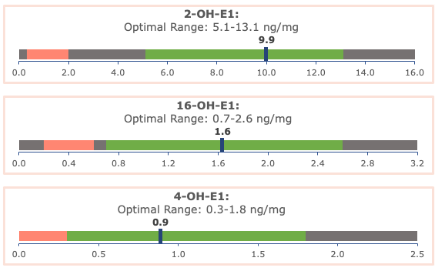
The luteal phase range for 2-OH-E1 is 5.1-13.1 ng/mg and the post menopausal range is 0.3-2.0 ng/mg.
2-OH-E1 levels are also reported as a percentage of all 3 Phase I metabolites. The preferred percentages in women are;
- 2-OH-E1 60-80%
- 4-OH-E1 7.5-11%
- 16-OH-E1 13-30%
Low 2-OH-E1 Levels:
Low levels of 2-OH-E1 may indicate that the less desirable 16-OH-E1 and 4-OH-E1 pathways may be preferred. 2-OH-E1 levels can be looked at in relation to these other metabolites and calculated in ratios.
A low 2-OH/16-OH ratio indicates a preference for the more proliferative 16-OH-E1 pathway, associated with proliferative conditions such as heavy bleeding, breast tenderness, endometriosis and fibroids.
A low 2-OH/4-OH ratio indicates a preference for the more potentially damaging 4-OH-E1 pathway which is linked to DNA damage.
Low levels of 2-OH-E1 can result in general symptoms of low estrogen, such as:
- Vaginal dryness
- Hot flashes
- Decreased libido
High 2-OH-E1 Levels:
Having elevated 2-OH-E1 levels is usually associated with beneficial effects, however sometimes it can be a sign of having high overall estrogen levels which can lead to symptoms such as;
- Breast tenderness
- Bloating
- Mood swings
- Heavy periods
- Weight gain
High 2-OH-E1 can be a sign that phase II and III estrogen detoxification is not optimal and needs some support. If levels are above range, this could indicate excessive phase I metabolism or a high clearance rate, leading to lower circulating levels of the estrogens E1 and E2 levels. Sluggish methylation in Phase 2 estrogen metabolism could also contribute to slower clearance of Phase 1 metabolites leading to hormonal symptoms.
In postmenopausal women receiving HRT, elevated levels of 2-OH-E1 may indicate that the dosing is too high which may be causing unwanted overstimulation of estrogen-sensitive tissue at the breasts and endometrium. Excessive levels of 2-OH-E1 may also increase the risk of osteoporosis in postmenopausal women with low oestrogen.
Which FUTURE WOMAN tests measure 2-OH-E1?
2-OH-E1 is measured in all three of our tests: the Classic Hormone Test, the Advanced Hormone Test and the Advanced+ Hormone Test with Cycle Mapping.
If you are not sure which test you need, our comparison guide walks through the differences.
Next steps
If your results suggest high or low 2-OH-E1 levels, this will be addressed in your personalised health plan by one of our experienced nutritionists. If you would like to learn more about your test results, remember you can purchase a 45 minute Hormone Health Consultation with your practitioner to discuss your results in more detail.
References
Al-Shami, K., Awadi, S., Khamees, A., Alsheikh, A. M., Al-Sharif, S., Ala’ Bereshy, R., Al-Eitan, S. F., Banikhaled, S. H., Al-Qudimat, A. R., Al-Zoubi, R. M., & Al Zoubi, M. S. (2023). Estrogens and the risk of breast cancer: A narrative review of literature. Heliyon, 9(9), e20224. https://doi.org/10.1016/j.heliyon.2023.e20224
Falk, R. T., Brinton, L. A., Dorgan, J. F., Fuhrman, B. J., Veenstra, T. D., Xu, X., & Gierach, G. L. (2013). Relationship of serum estrogens and estrogen metabolites to postmenopausal breast cancer risk: a nested case-control study. Breast cancer research : BCR, 15(2), R34. https://doi.org/10.1186/bcr3416
Parl, F. F., Dawling, S., Roodi, N., & Crooke, P. S. (2009). Estrogen metabolism and breast cancer: a risk model. Annals of the New York Academy of Sciences, 1155, 68–75. https://doi.org/10.1111/j.1749-6632.2008.03676.x
Zhu, B. T., Han, G. Z., Shim, J. Y., Wen, Y., & Jiang, X. R. (2006). Quantitative structure-activity relationship of various endogenous estrogen metabolites for human estrogen receptor alpha and beta subtypes: Insights into the structural determinants favoring a differential subtype binding. Endocrinology, 147(9), 4132–4150. https://doi.org/10.1210/en.2006-0113
Ziegler, R. G., Fuhrman, B. J., Moore, S. C., & Matthews, C. E. (2015). Epidemiologic studies of estrogen metabolism and breast cancer. Steroids, 99(Pt A), 67–75. https://doi.org/10.1016/j.steroids.2015.02.015